Indigenous Ecotourism and Sustainable Development:
The Case of Río Blanco, Ecuador David T. Schaller
Department of Geography
University of Minnesota |
Versión Español - Physical and Human Geography of Napo Province
- The Association of Río Blanco
- Case Study Methods: Quichua Interviews
- The Struggle for Land Tenure
- A Growing Community
- The Expansion of Agriculture
- The Reserves
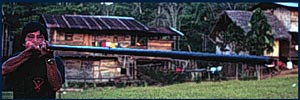 Summary: The indigenous Quichua community of Río Blanco, in the Ecuadorian Amazon (Napo Province), was founded in 1971 by Quichua migrants from the Andean foothills, where, as a result of population growth and inmigration of mestizo agricultural colonists, the supply of land was becoming short. Since 1971, the economy of Río Blanco has shifted from one based almost entirely on subsistence agriculture and hunting to one reliant on cash crops such as coffee, cacao, rice and maize. Río Blanco has experienced high population growth in the past twenty years which, along with a rising cost of living, has driven the people of the community to expand greatly the amount of land under cultivation. As a result, the amount of primary tropical forest has decreased until, in 1995, it accounted for less than half of the community's main block of land. Facing continued population growth, the community has developed an ecotourism project as an alternative economic activity which may protect the forest rather than clear it.
- What is Ecotourism?
- Tourism in Napo Province
- A Model for Indigenous Ecotourism Development
Summary: Ecotourism has attracted increasing attention in recentyears, not only as an alternative to mass tourism, but as a means of economicdevelopment and environmental conservation. Proponents and some scholarsbelieve that it can potentially focus the benefits of tourism on the localpopulation and environment while minimizing negative impacts. Other observersremain skeptical, warning that ecotourism has not yet been proven to be eitherbeneficial or sustainable. A growing number of researchers agree that localcontrol is key to avoiding many problems resulting from ecotourism development. By scaling down production processes and returning power to local units ofgovernance, ecotourism may reduce economic leakages, minimize negative impactsand concentrate the benefits locally. However, the international nature oftourism creates many obstacles for localities wishing to maintain control oftheir tourism industry. Too often, local people have neither the politicalpower nor the business connections to compete at an international level withmetropolitan tour agencies. Nevertheless, ecotourism's rapid growth hasattracted the attention of many people and communities in low-income countries. In the Ecuadorian Amazon, a growing number of indigenous Quichua communities areturning to ecotourism as an alternative to expanded commercial agriculture. RíoBlanco has joined a network of Quichua communities which are developing theirown ecotourism projects.
- Communal by Design
- Case Study Methods: Tourist Interviews
- Perceptions of the Tropical Forest
- Accuracy of the Ecotourism Experience
- Authenticity of the Ecotourism Experience
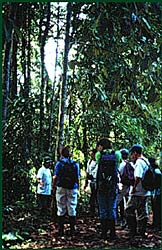
 Summary: Two main tenets of Río Blanco's project are communal control and small scale. Work is assigned equitably so all member-families of Río Blanco contribute to and benefit from ecotourism. In the project's first year, 150 tourists visited. Each family earned about $100 in the first year, or about one-fifth of their income for the year. Most members would like to receive about 300 tourists in 1996, thus maintaining the project's small scale. Tourists visiting Río Blanco range from small groups of independent tourists to students and teachers in groups of ten or twenty who are part of a tour run by a nearby biological field station. A group of fifteen students interviewed after their visit expressed satisfaction with their experience in Río Blanco, though evidence suggests that their visit did not give them an accurate portrayal of contemporary Quichua life. Whereas the people of Río Blanco rarely spend time in primary forest, owing to their agricultural obligations, tourists spend virtually all their time in primary forest. Few tourists interviewed believed that commercial agriculture was a significant part of the community's economy, indicating that they had learned little about a central aspect of community life.
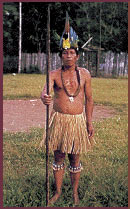
However, many tourist-respondents were confused and evenupset by the cultural program, in which the people of the community wore thetraditional grass skirts and red body paint of their ancestors and performedtraditional Quichua music and dances. Many tourist-respondents questioned theauthenticity of these performances, since they appeared incongruent withcontemporary Quichua life. These concerns echoed scholarly research intotourism and authenticity, which postulate both a touristic need for authenticityand the ubiquity of "staged authenticity," which may only frustratethe earnest seeker of true authenticity. Ironically, in Río Blanco therediscovery of traditional music and dance for tourism purposes may well lead toits reincorporation into community festivals, increasing its authenticity in thetourism program.
- Ecotourism as Development, Part One
- The Benefits and Costs of Ecotourism Development
- Ecotourism as Development, Part Two
- Threats to Ecotourism's Sustainability
- The Means and the Ends
Summary: The potential of Río Blanco's ecotourism project assustainable, appropriate development currently appears strong. While not allQuichua respondents indicated that they saw the connection between tourismdevelopment and forest preservation, a growing conservationist ethic amongmembers suggests that such a linkage may be evolving. It remains unclear,however, how this ethic will affect agricultural activity. Most respondentsreported that they would rather increase tourism than agricultural production,but nearly half also said they intended to clear more forest for cultivation. Many members may have difficulty accepting the opportunity costs of furtherecotourism development. Until the community decides how much trust it can placein ecotourism as a reliable and sustainable economic activity, agriculture willprobably continue to expand.
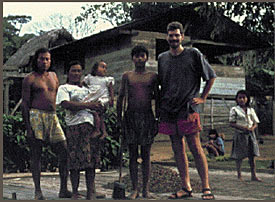 In the evaluation of development schemes, what is of prime importance for both community members and the coordinators of Quichua ecotourism projects is the survival of Quichua culture. If Río Blanco's ecotourism project does not disrupt established social and political structures of the community, it may qualify as appropriate development even though it is not a traditional form of development. Furthermore, it may serve as a tool to help rural Quichua learn business skills which are crucial if they are to succeed in dealings with mestizo residents of the area as well as with other Ecuadorian and foreign parties. In this way, ecotourism may not be an end in itself but merely a bridge to the future. The sustainability of a particular ecotourism project may be irrelevant in the long run. What matters is its impact on the local people and environment, and how well it serves them against the challenges ahead.
Interested in visiting Río Blanco?
This research was supported by a fellowship from the Department of Geography, University of Minnesota.
If you have any questions or comments about this site or the information you find here, contact me at David@Schaller.com.  to Ecotourism Research Home Page
  Section 2: Ecotourism in theory and practice